

If you’ve landed here searching for a javert definition, you’re probably running into the same problem everyone else does: half the internet treats “Javert” as a fictional character from a 160-year-old French novel, and the other half treats it as a real English word you’d find in a dictionary. Both are true. This guide gives you the actual javert definition, explains how a 19th-century police inspector turned into a word people use in everyday conversation, and shows you exactly how to use it correctly.
Quick Answer: Javert Definition in One Line
Javert (noun, informal/literary eponym): a person who enforces rules, laws, or moral codes with obsessive, unforgiving rigidity, showing no capacity for mercy even when mercy is clearly justified.
That’s the working javert meaning most dictionaries and usage guides agree on. It’s not a formally standardized word — you won’t find it in Merriam-Webster — but it appears in Wiktionary and shows up regularly in journalism, film criticism, and everyday speech when someone wants to describe a person who is rigid, punitive, and incapable of bending a rule even when bending it would be the right thing to do.
How Do You Pronounce Javert?
Before getting into the deeper javert definition, it helps to know how to actually say the word, since most search results skip this entirely.
- English pronunciation: juh-VAIR
- Original French pronunciation: /ʒavɛʁ/ — roughly “zha-VAIR,” with a soft “j” sound like the “s” in “measure”
Most English speakers use the anglicized “juh-VAIR” version, and that’s perfectly acceptable in casual conversation. If you’re discussing the original Victor Hugo novel or French literature specifically, the French pronunciation is more accurate.
Where the Word Comes From
Every accurate javert definition starts with the same origin point: Victor Hugo’s 1862 novel Les Misérables. Javert is the novel’s primary antagonist — a police inspector who spends decades pursuing Jean Valjean, a former convict trying to build an honest life after breaking parole.
Javert isn’t a historical figure. He’s entirely fictional. But the character was written with such a specific, consistent personality — total devotion to law, zero tolerance for exceptions, complete absence of empathy for anyone who breaks a rule regardless of the reason — that his name eventually detached from the novel and became shorthand for that exact personality type. That’s the linguistic mechanism behind the modern javert definition: readers and writers needed a quick way to describe “a person who is rigidly, punitively law-abiding,” and Javert’s name did the job better than any existing word.
This is the same process that turned “Scrooge” into a word for a miser, or “quixotic” into a word for impractical idealism. Fictional characters become common nouns when their personalities are distinctive enough to be instantly recognizable without further explanation.
Why Javert Became a Definition Instead of Staying Just a Character Name
This is the part most articles skip entirely, and it’s the most important piece of any real javert definition: not every fictional character becomes a word. Most don’t. So why did Javert?
He represents a single, extreme idea
Javert isn’t a complicated character in the sense of having many competing traits. Hugo built him around exactly two principles: respect for authority and hatred of rebellion. That narrowness is actually what made him useful as a word. A word needs to represent one clear idea to be usable in conversation, and Javert represents one idea with almost no ambiguity.
His downfall reinforced the definition
Javert’s arc ends in suicide, triggered by a moral crisis: Valjean, the man he’s hunted for decades, spares his life. Javert cannot reconcile mercy with his worldview, and the contradiction destroys him. This ending matters for the javert definition because it cemented the character as a cautionary figure, not just a strict one — someone whose rigidity is ultimately self-destructive, not admirable.
The musical and films kept the name circulating
The 1980 stage musical and its multiple film adaptations (1998, 2012, and the 2018 PBS/BBC miniseries) kept Javert in mainstream pop culture for generations who never read Hugo’s 1,500-page novel. Popular exposure is a requirement for any character-based word to survive — Javert had it in abundance.
Character Traits Behind the Javert Definition
To fully understand the javert definition, it helps to break down exactly which traits get attributed to someone when they’re called “a Javert” or described as “Javert-like.”
- Rigid legalism — believes the letter of the law matters more than the spirit or intent behind it
- No capacity for mercy — treats forgiveness or leniency as a moral failure, not a virtue
- Black-and-white worldview — sees people as either fully lawful or fully criminal, with no middle ground
- Obsessive persistence — will pursue a goal or target for years without wavering
- Self-denial — Hugo describes Javert’s life as one of privation and isolation; he has no personal vices, no hobbies, nothing outside his duty
- Inability to adapt — when faced with evidence that contradicts his worldview, he breaks rather than bends
These traits are what someone means when they invoke the javert definition in a modern context — they’re not usually talking about French police inspectors. They’re describing a personality type.
How to Use “Javert” in a Sentence
Since most dictionary sources give you a one-line definition and nothing else, here’s what the javert definition actually looks like in real usage:
- “The new compliance officer is a total Javert — he flagged a $12 expense report over a missing signature.”
- “Critics called the film’s antagonist a modern Javert, chasing the protagonist over a decades-old parking violation.”
- “She admired the law, but she wasn’t a Javert about it; she knew when a rule needed bending.”
- “His Javert-like obsession with the rulebook cost him the trust of his entire team.”
Notice the pattern: the word is almost always used critically. Calling someone “a Javert” is rarely a compliment — it implies they’ve lost sight of fairness in favor of rigid rule enforcement.
Javert vs. Similar Literary Eponyms
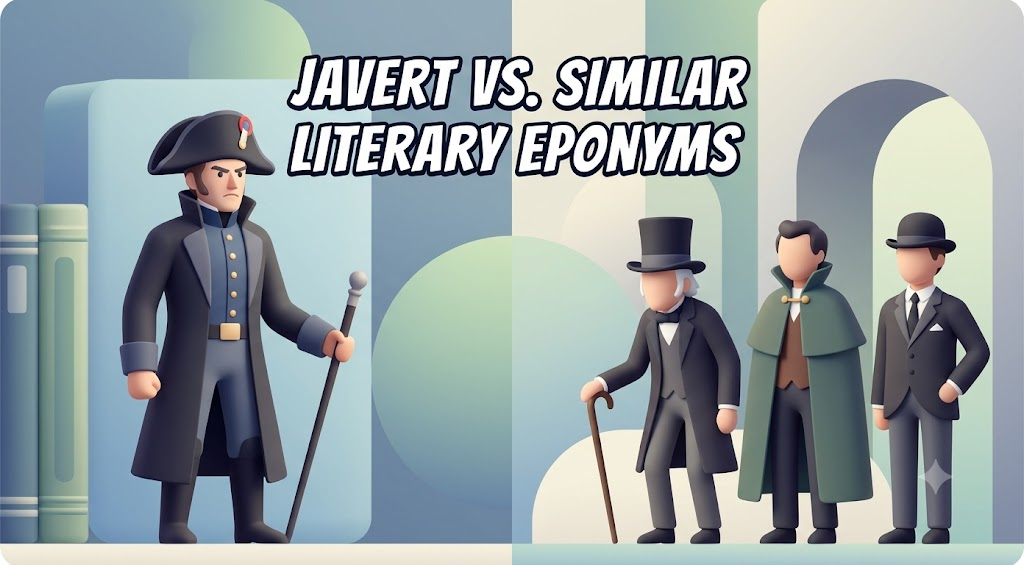
The javert definition makes more sense when you compare it to other fictional characters whose names became words. Here’s how Javert stacks up:
| Eponym | Origin | Core Meaning | Tone |
|---|---|---|---|
| Javert | Les Misérables (Hugo, 1862) | Rigid, merciless law enforcement | Critical |
| Scrooge | A Christmas Carol (Dickens, 1843) | Miserly, stingy with money | Critical |
| Quixotic | Don Quixote (Cervantes, 1605) | Idealistic to the point of impracticality | Mixed |
| Machiavellian | Niccolò Machiavelli’s The Prince | Cunning, manipulative, power-focused | Critical |
| Big Brother | 1984 (Orwell, 1949) | Invasive government surveillance | Critical |
This comparison table is useful because it places the javert definition in its correct linguistic category: a critical eponym describing an extreme, usually unflattering, personality trait — not a neutral descriptor.
Javert: Novel vs. Musical Differences
A lot of confusion around the javert definition comes from people who only know Javert through the musical, not Hugo’s original novel. The core personality is the same, but the emphasis differs slightly:
| Feature | Hugo’s Novel (1862) | Stage Musical (1980) |
|---|---|---|
| Backstory | Detailed — born in prison, ashamed of Romani parentage | Minimal — backstory largely omitted |
| Internal conflict | Explored gradually over hundreds of pages | Compressed into two songs (“Stars,” “Javert’s Suicide”) |
| Motivation | Framed as philosophical/religious crisis | Framed as emotional breakdown |
| Ending | Same — suicide by drowning in the Seine | Same — suicide by drowning in the Seine |
Both versions support the same javert definition, but the novel gives you the psychological “why” behind the rigidity, while the musical gives you the emotional shorthand.
Who Was Javert, Really?
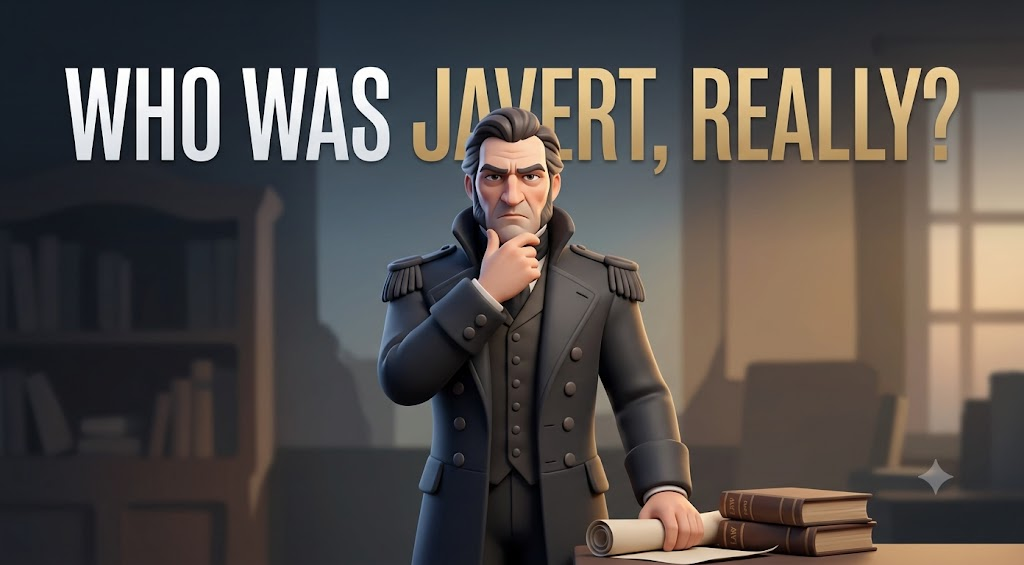
Beyond the word itself, it’s worth understanding the character behind the javert definition in more depth. Javert was born in a French prison; his mother was a fortune-teller, and his father served time as a convict. Ashamed of this background, Javert built his entire identity around law enforcement — first as a prison guard, later as a police inspector. He becomes convinced that criminals cannot reform, a belief that puts him in direct, permanent conflict with Jean Valjean, a man who breaks parole but goes on to live an honest, generous life.
For most of the novel, Javert is Valjean’s shadow, appearing at nearly every major turning point to threaten his freedom. The tragedy of the character — and the reason the javert definition carries such a specific emotional weight — is that Javert isn’t written as evil. He’s written as someone whose devotion to order is so absolute that it leaves no room for the flexibility real justice sometimes requires. When Valjean spares Javert’s life during the student uprising near the novel’s end, Javert cannot process an act of mercy from a man he’s spent decades condemning. Unable to reconcile the law with what he now knows to be right, he drowns himself in the Seine.
That contradiction — a man destroyed not by cruelty but by an inability to forgive — is exactly why “Javert” survived as a word long after most readers stopped picking up 1,500-page French novels.
Frequently Asked Questions
Is “Javert” a real word in the dictionary?
It’s listed in Wiktionary as an informal eponym, but it hasn’t been formally added to major dictionaries like Merriam-Webster. It’s widely understood and used, just not yet standardized.
What does it mean to call someone “a Javert”?
It means the person enforces rules or laws with excessive rigidity and no willingness to consider context, exceptions, or mercy.
Is Javert based on a real historical person?
No. Javert is entirely fictional, created by Victor Hugo for Les Misérables in 1862. There’s no confirmed real-life inspiration.
Why does Javert kill himself in the story?
He can’t reconcile his rigid belief in the law with Jean Valjean showing him mercy, an act that contradicts everything he’s built his identity around.
Is Javert the villain of Les Misérables?
He functions as the antagonist because he opposes Valjean throughout the story, but Hugo writes him as a tragic figure rather than a purely evil one.
How do you pronounce Javert correctly?
In English, it’s commonly said as “juh-VAIR.” The original French pronunciation is closer to “zha-VAIR.”
What’s the difference between Javert and a strict rule-follower?
A strict rule-follower can still recognize exceptions. The javert definition implies someone who refuses to acknowledge exceptions exist at all, even when the situation clearly calls for one.
The Bottom Line
The javert definition isn’t complicated once you separate the word from the 1,500-page novel it came from. At its core, it describes a person defined by rigid law enforcement, zero tolerance for exceptions, and a worldview so absolute it eventually becomes self-destructive. Whether you encountered the name through Hugo’s original text, the stage musical, or one of the film adaptations, the word now carries a life of its own — one that shows up in journalism, casual conversation, and character criticism far beyond the pages of Les Misérables. Next time you hear someone described as “a real Javert,” you’ll know exactly what that means, and exactly where it came from.
