

If you’ve been texting someone for weeks and still don’t know what you actually are to each other, you’ve probably run into the term DTR. Understanding the DTR meaning isn’t just about decoding slang — it’s about knowing when and how to ask for clarity in a relationship before confusion turns into resentment.
This guide breaks down the DTR meaning in plain language, explains where it came from, what real research says about why people avoid it, and gives you actual scripts you can use — not vague advice to “just communicate.”
What Does DTR Mean? The Straightforward Answer
DTR stands for Define The Relationship. It refers to a conversation, usually between two people who’ve been dating or talking regularly, where one or both people want to clarify:
- Whether they’re exclusive or still seeing other people
- What labels apply (dating, boyfriend/girlfriend, situationship)
- What each person expects going forward
The DTR meaning centers on removing ambiguity. It’s the moment two people stop assuming what’s going on and start actually saying it out loud.
Most competitor definitions stop here. But the DTR meaning only becomes useful once you understand the context it shows up in — texting, dating apps, and the specific moment in a relationship where it tends to surface.
Where the DTR Meaning Comes From
The phrase “define the relationship” predates texting slang entirely. It shows up in relationship advice columns and dating culture discussions going back decades, long before it got compressed into an acronym for messaging.
As dating moved from clear, staged progressions (dating → going steady → engaged) to looser, undefined arrangements, people needed a shorthand for the moment they wanted to press pause and ask “what are we?” That shorthand became DTR.
A 2022 qualitative study out of the University of Texas at Austin looked directly at this. Researchers conducted 40 semi-structured interviews specifically to understand what happens before, during, and after a DTR conversation — one of the only academic attempts to actually map the process rather than just describe it. Their findings point to a few consistent patterns:
- DTR conversations are rarely a single clean moment — they often build gradually through smaller check-ins
- The conversation is shaped as much by what happens after it as by the conversation itself
- People frequently misjudge how their partner will respond, which is part of why the talk gets delayed
This matters because most content explaining the DTR meaning treats it like a single scripted event. In reality, it’s closer to a process with multiple checkpoints.
DTR Meaning Beyond Dating (Medical, Work, and Tech)
Not every search for DTR meaning is about relationships. The letters get reused across several unrelated fields, and if you landed here for one of these, here’s the actual answer.
DTR in Medical Settings
In clinical environments, DTR usually stands for Deep Tendon Reflex — the reflex response tested when a doctor taps a tendon (like the knee-jerk reflex) with a reflex hammer. It’s a standard part of a neurological exam used to check nerve function.
DTR at Work
In workplace contexts, DTR commonly refers to a Daily Time Record or Daily Task Report — a log used to track attendance, hours worked, or tasks completed. The exact meaning depends entirely on the company or industry using it.
DTR in Tech
In older computer and telecom systems, DTR stands for Data Terminal Ready, a signal used in RS-232 serial communication to tell a modem that a connected device is ready to communicate. It’s largely a legacy term at this point but still shows up in networking documentation.
Here’s a quick reference table for all common DTR meanings:
| Context | What DTR Stands For | Typical Use |
|---|---|---|
| Dating/texting | Define The Relationship | Clarifying relationship status |
| Medical | Deep Tendon Reflex | Neurological exams |
| Workplace | Daily Time Record / Daily Task Report | Attendance or task tracking |
| Tech/telecom | Data Terminal Ready | Serial communication signaling |
If you searched for the DTR meaning expecting the dating definition, the rest of this guide focuses there.
Why the DTR Conversation Feels So Hard (What Research Actually Shows)
Knowing the DTR meaning doesn’t make the conversation itself easier. Most people delay it, and it’s not just nerves — there are specific, identifiable reasons.
- Fear of a mismatched answer. If one person suspects the other isn’t ready to commit, they’d rather stay in comfortable ambiguity than risk a definitive “no.”
- Loss aversion. Ending an undefined arrangement feels riskier than continuing it, even if the arrangement isn’t satisfying.
- Timing anxiety. People consistently misjudge whether it’s “too early” or “too late” to bring it up, which causes them to wait past the point where the conversation would feel natural.
- Avoidance of conflict. Some people conflate defining a relationship with confrontation, when in practice it’s usually closer to a check-in than an argument.
None of this is a character flaw — it’s a predictable pattern the UT Austin research and related relationship literature both point to. Understanding that the hesitation is normal is often the first step toward actually having the talk.
When Is the Right Time to DTR?

There’s no universal rule, but timing does follow patterns. Here’s a general guide:
| Timing | What It Usually Signals |
|---|---|
| After 1–2 dates | Generally too early — you don’t have enough information about each other yet |
| 3–8 weeks of regular dating/texting | The most common window for a first DTR conversation |
| 2–3+ months without any clarity | Often a sign the talk has been delayed too long, and ambiguity is starting to cause stress |
| After a major shift (meeting friends, a trip together, exclusivity implied but unstated) | A natural, low-pressure moment to bring it up |
A few signs it’s time to have the conversation:
- You’re unsure whether to mention this person to friends or family as “someone I’m dating” or “someone I’m seeing”
- You’ve stopped talking to or seeing other people, but haven’t said so out loud
- You feel anxious checking your phone, wondering where things stand
- You’ve noticed inconsistent effort and want to know if it’s mutual
How to Actually Start the DTR Conversation (Real Scripts)
Most guides tell you to “just be honest” without giving you anything to actually say. Here are real openers for different situations.
If You’ve Been Dating a Few Weeks
“I’ve really been enjoying spending time with you, and I wanted to check in — are we on the same page about where this is going?”
If You’re Long-Distance
“Since we don’t see each other every day, I want to make sure we’re both clear on what we are to each other, especially with the distance.”
If You Suspect They’re Seeing Other People
“I’m not trying to make this a big deal, but I’d like to know if we’re exclusive or if you’re still seeing other people.”
If You’re the One Being Asked
If someone brings up the DTR conversation with you first, it helps to respond honestly rather than deflecting:
“I appreciate you bringing it up. Honestly, I’ve been enjoying this too — I think I’m ready to be exclusive if you are.”
or, if you’re not there yet:
“I like where things are, but I’m not sure I’m ready to put a label on it yet. Can we revisit this in a few weeks?”
What Happens After a DTR Conversation? The Four Outcomes
A common gap in most explanations of the DTR meaning is that they only describe one possible ending — skink meaning becoming official. In reality, there are four realistic outcomes:
| Outcome | What It Looks Like |
|---|---|
| Mutual exclusivity | Both people agree to stop seeing others and define the relationship |
| Mutual “keep it casual” | Both people agree they’re not ready for labels, and continue as-is knowingly |
| Mismatch | One person wants more, the other doesn’t — leading to a decision about whether to continue |
| Clean end | The conversation reveals incompatible expectations, and the relationship ends there |
None of these outcomes mean the conversation failed. The point of understanding the DTR meaning isn’t to guarantee a specific result — it’s to replace guessing with actual information.
DTR vs Other Relationship Terms
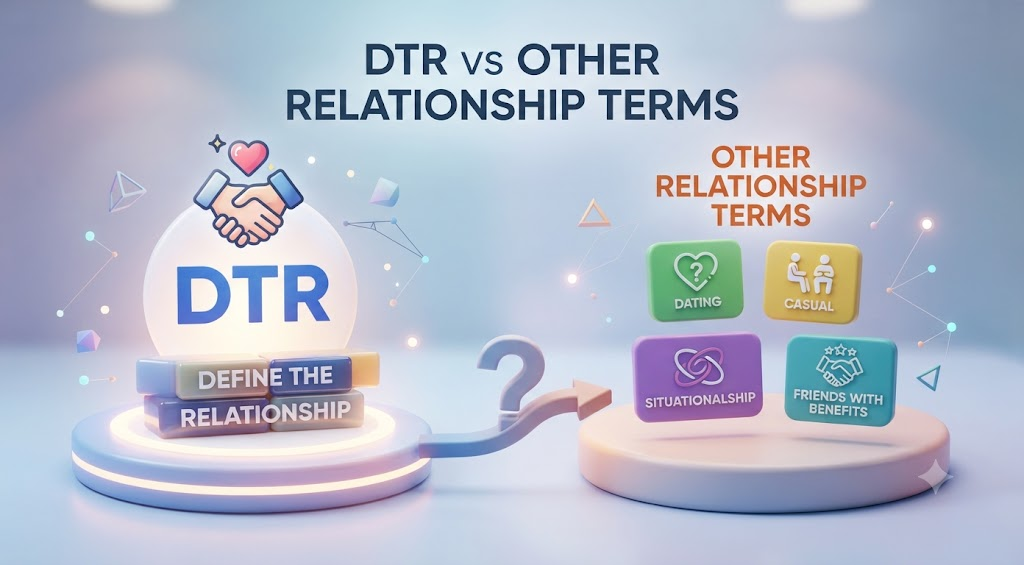
Because DTR often gets used alongside similar phrases, here’s how it compares:
| Term | What It Means | How It Differs from DTR |
|---|---|---|
| “The talk” | General term for a serious relationship conversation | Often used interchangeably with DTR, but can also refer to unrelated serious topics (finances, moving in) |
| Situationship check-in | A lighter conversation about ongoing casual dynamics | Doesn’t necessarily aim for a defined label, just clarity on current terms |
| Exclusivity talk | Specifically about whether both people are seeing others | A narrower version of DTR focused only on exclusivity, not full relationship status |
| Breakup conversation | Ending the relationship | The opposite intent — DTR is meant to clarify or strengthen, not end |
Signs You Need to DTR Soon (Checklist)
- You find yourself overanalyzing texts to guess where you stand
- You’ve avoided dating other people without discussing it
- Friends or family have started asking “so what are you two, exactly?” and you don’t have an answer
- You’ve had an emotionally significant moment (meeting parents, a trip, a rough patch) without addressing what it means for the relationship
- You feel more invested than you think the other person realizes
If two or more of these apply, it’s a reasonable signal that the DTR conversation is overdue.
Frequently Asked Questions
What does DTR mean in texting?
DTR stands for “Define The Relationship” — it’s used when someone wants to clarify the status of a romantic connection over text or chat.
Is DTR only used in dating contexts?
No. While the DTR meaning in dating is the most common usage, DTR also refers to Deep Tendon Reflex in medicine, Daily Time Record at work, and Data Terminal Ready in tech.
Who usually brings up the DTR conversation first?
Either person can initiate it, though research suggests it’s often whoever feels the most uncertainty or emotional investment at the time.
Is it a bad sign if someone wants to DTR?
Not necessarily. Wanting to DTR usually signals a desire for clarity and honesty, not dissatisfaction with the relationship itself.
How long should you wait before having a DTR conversation?
There’s no fixed timeline, but somewhere between three and eight weeks of consistent dating is a common window, especially once exclusivity feels implied but hasn’t been confirmed.
What if the DTR conversation doesn’t go the way I want?
That’s a real possibility, and it’s still useful information. Knowing where you stand — even if it’s not the answer you hoped for — is more actionable than staying in ambiguity.
Can a DTR conversation happen more than once?
Yes. Relationships change, and it’s common to revisit the conversation as circumstances shift, especially after major life changes or unresolved tension.
Understanding the DTR meaning is really about recognizing a simple truth: ambiguity in a relationship doesn’t resolve itself. Whether you’re the one initiating the conversation or responding to it, having language ready — and knowing that hesitation is normal — makes the whole process far less intimidating than it feels in the moment.
