

If you searched for skink meaning, you probably landed on one of two very different types of pages: a dry dictionary definition, or a vague spiritual article that never actually explains the animal itself. This guide combines both — the real definition, the biology, and the symbolism — with facts you can actually verify.
Skinks are one of the most common lizards in the world, yet most people confuse them with regular lizards, salamanders, or even snakes. Understanding the true skink meaning requires looking at three things: the word’s origin, the animal’s biology, and the cultural stories built around it. That’s exactly what this article covers.
What Is the Skink Meaning in Simple Terms?
In plain English, the skink meaning refers to a type of lizard belonging to the family Scincidae. Skinks have smooth, shiny scales, short or absent legs, and elongated bodies. They are one of the largest lizard families on Earth, with more than 1,500 known species living on every continent except Antarctica.
There’s also a second, much older skink meaning that has nothing to do with reptiles. In old Scottish and northern English dialect, “skink” referred to a weak or poor-quality alcoholic drink, and as a verb, it meant “to pour or serve a drink.” This meaning is largely obsolete today but still appears in historical texts and dictionaries.
So when someone asks about the skink meaning, the correct answer depends on context — and almost every modern usage refers to the lizard.
The Two Different Skink Meanings You Should Know
Most dictionary sites mention both definitions but never explain why they exist side by side. Here’s the breakdown.
Skink Meaning #1 — The Lizard
This is the meaning almost everyone is searching for. A skink is:
- A member of the lizard family Scincidae
- Known for smooth, glossy, overlapping scales
- Found in warm climates across the Old and New World
- Often mistaken for a snake because some species have tiny or no visible legs
- Typically harmless to humans and non-venomous
Skink Meaning #2 — The Archaic Word for Weak Drink
This older skink meaning comes from a completely different linguistic root and survives mainly in historical or regional dialect use:
| Term | Meaning | Region/Era |
|---|---|---|
| Skink (noun) | A weak, poor-quality drink | Scottish, Northern English dialect |
| Skink (verb) | To pour or serve alcohol | Middle English period |
| Cullen skink | A traditional Scottish smoked fish soup | Modern Scottish cuisine |
Interestingly, “cullen skink” — the soup — actually comes from this second meaning, not the lizard. That’s why you’ll sometimes see the word “skink” pop up unexpectedly in recipe articles.
Where Does the Word “Skink” Come From?
Understanding etymology helps explain why the skink meaning split into two unrelated definitions in the first place.
- The reptile meaning traces back to the Latin word scincus, which itself came from the Ancient Greek skínkos, meaning “lizard.”
- The drink/verb meaning comes from Middle English skynken, derived from Middle Dutch schenken or schinken, related to Old English scencan (“to pour out drink”) and German schenken.
These two word histories developed independently and simply happen to share the same spelling in modern English — a coincidence of language, not a shared origin. No major dictionary site currently explains this clearly, even though it’s the most common point of confusion around the term.
What Does a Skink Look Like?
If you’re trying to identify a skink in your yard, here are the physical traits that separate it from other reptiles:
- Smooth, shiny scales that look almost metallic or polished
- Short legs or no visible legs in some species
- A long, tapering tail, often brightly colored in young skinks (commonly blue)
- A cylindrical, elongated body rather than a flat one
- Small, rounded head without the pronounced neck seen in true lizards like geckos
Because of the smooth scales and short limbs, skinks often move with a snake-like wiggle rather than the typical scurrying walk of other lizards. This is one of the most searched follow-up questions related to skink meaning — people want to know if what they saw was a skink or a snake.
Common Types of Skinks in the United States
The full skink meaning search intent frequently comes from people who just spotted one in their garden or garage. Here are the species most commonly found across the U.S.
Five-Lined Skink
Native to the eastern United States, this species is known for five pale stripes running down its body and, in juveniles, a bright blue tail that fades with age.
Blue-Tailed Skink
Not a distinct species but a common nickname for juvenile five-lined or broad-headed skinks, easily recognized by their vivid electric-blue tails.
Blue-Tongued Skink
Native to Australia but popular in the U.S. exotic pet trade, this species is famous for flashing a bright blue tongue as a defense display to startle predators.
Ground Skink
A small, brown, secretive species found throughout the southeastern U.S., often mistaken for a worm or small snake due to its tiny legs.
| Species | Region | Notable Feature |
|---|---|---|
| Five-Lined Skink | Eastern U.S. | Striped body, blue juvenile tail |
| Blue-Tailed Skink | Eastern/Southern U.S. | Bright blue tail (juvenile stage) |
| Blue-Tongued Skink | Australia (kept as pets in U.S.) | Blue tongue defense display |
| Ground Skink | Southeastern U.S. | Tiny legs, ground-dwelling |
Skink Behavior: Facts That Explain Its Reputation
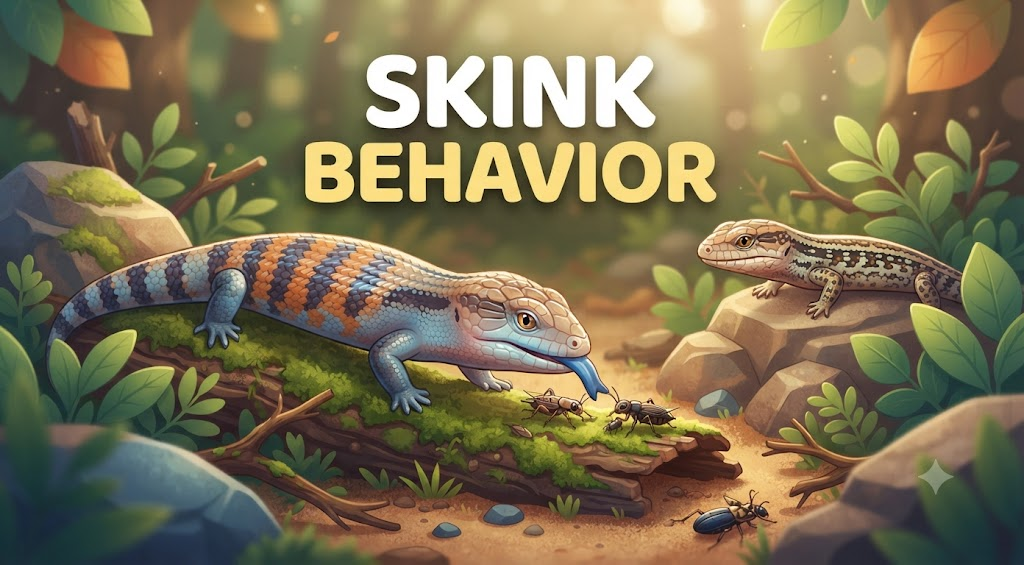
Before diving into symbolism, it helps to understand the real behavior behind the skink meaning people attach to folklore and spirit-animal content. These facts are the actual biological basis for most symbolic claims.
- Tail autotomy: Skinks can detach their tails when grabbed by a predator. The tail keeps wiggling on its own, distracting the predator while the skink escapes. A new tail regrows within 60 to 90 days, though it’s shorter and made of cartilage instead of bone.
- Burrowing: Many species dig into loose soil, leaf litter, or sand to escape heat and predators.
- Speed: Skinks are fast movers, often darting away before you can get a clear look.
- Diet: Most skinks eat insects, spiders, and small invertebrates, making them beneficial for gardens.
- Docile nature: Skinks are not aggressive and rarely bite unless directly handled or cornered.
These traits — regeneration, quick escape, camouflage, and calm behavior — are exactly what symbolic and spiritual interpretations are built on.
The Spiritual and Symbolic Skink Meaning
Separate from the dictionary definition, many people search for the skink meaning in a symbolic or spiritual sense. It’s important to note upfront: these interpretations come from folklore and modern symbolic writing, strip chart meaning not verified anthropological sources, so they should be read as cultural interpretation rather than fact.
Adaptability and Change
Because skinks shed and regrow their tails, they’re commonly associated with resilience, healing, and moving on from difficult periods. The biological process of tail regeneration is often used as a metaphor for personal recovery.
Protection and Healing
The skink’s ability to escape danger through tail-dropping has led to symbolic associations with self-protection and letting go of what no longer serves a person, particularly in modern spiritual writing communities.
Grounding and Awareness
Since skinks live close to the ground, move quietly, and rely on stealth rather than aggression, some symbolic traditions connect them to patience, observation, and quiet strength rather than force.
Here’s a quick reference table separating fact from folklore:
| Skink Trait | Biological Fact | Symbolic Interpretation |
|---|---|---|
| Tail dropping | Escape mechanism from predators | Letting go, healing, renewal |
| Ground-dwelling | Avoids heat and predators | Grounding, awareness, patience |
| Fast movement | Predator avoidance | Adaptability, quick decision-making |
| Bright blue tail (juveniles) | Predator distraction/decoy | Protection, vitality |
Skink vs. Lizard vs. Salamander: Clearing Up the Confusion
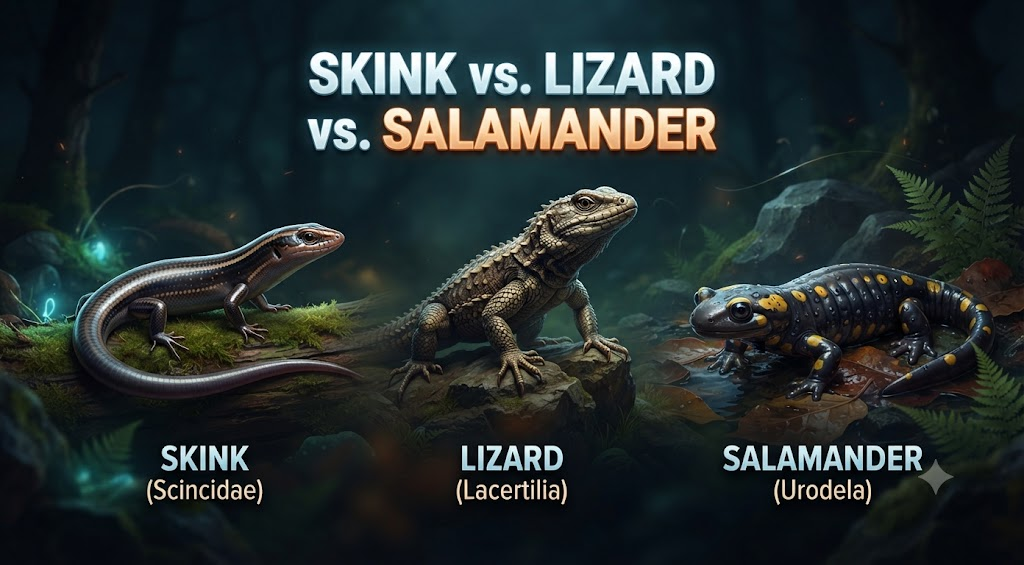
A large part of the confusion around skink meaning comes from mixing it up with other small reptiles and amphibians. Here’s a simple comparison:
- Skink: A reptile with dry, smooth, overlapping scales; legs may be short or absent; lives on land.
- Lizard (general term): Skinks are technically a type of lizard, but the general term includes other families like geckos and iguanas with different scale textures and body shapes.
- Salamander: An amphibian, not a reptile, with moist, smooth skin (no scales), and it typically needs to stay near water or damp environments to survive.
The easiest way to tell them apart: reptiles like skinks have dry, scaled skin, while salamanders have moist, glandular skin. If the animal feels dry and shiny, it’s a skink or lizard. If it looks slimy or wet, it’s likely a salamander.
Is a Skink Dangerous? Separating Fact from Myth
One of the most searched questions tied to skink meaning is whether skinks pose any danger to humans or pets. Here’s the short answer:
- Skinks are not venomous
- They rarely bite, and when they do, it’s minor and harmless
- They do not carry any known disease risk significant to humans through normal contact
- They are generally beneficial, since they eat garden pests like insects and spiders
If you find a skink in your house or garage, it’s typically just seeking shade or hunting insects, not a threat of any kind.
Frequently Asked Questions
What is the basic skink meaning?
A skink is a type of lizard from the family Scincidae, recognized by its smooth, shiny scales and short or absent legs.
Are skinks and lizards the same thing?
Skinks are a specific family within the broader lizard group, so all skinks are lizards, but not all lizards are skinks.
Do skinks bite humans?
Skinks rarely bite, and if they do, it’s minor and not dangerous; they generally avoid confrontation and flee instead.
Why does a skink lose its tail?
Skinks drop their tails as a defense mechanism to distract predators, allowing them to escape while the tail regrows over 60 to 90 days.
What does it mean if a skink is in my house?
It usually means the skink is seeking shade, moisture, or hunting insects nearby — it is not a sign of danger or infestation.
Is the blue-tailed skink a separate species?
No, the bright blue tail is typically a juvenile trait found in species like the five-lined skink, and it usually fades as the lizard matures.
What is the spiritual skink meaning?
In folklore and modern symbolic writing, skinks are often associated with adaptability, healing, and quiet resilience, based on their tail-regeneration ability.
Can skinks be kept as pets?
Yes, species like the blue-tongued skink are commonly kept as pets in the United States and are known for being calm and easy to handle.
Is a skink poisonous to touch?
No, skinks are not poisonous or venomous, and it’s safe to touch or handle most species, though careful handling is recommended to avoid stressing the animal.
